
You are using an out of date browser. It may not display this or other websites correctly.
You should upgrade or use an alternative browser.
You should upgrade or use an alternative browser.
For Love of Blog and Allosaur Discussion
- Thread starter turgy22
- Start date

Oversoul
The Tentacled One
Many others have made Magic's nonsensical taxonomy the butt of jokes. I've certainly done so myself. Pygmy Allosaurus is probably the most egregious erratum in this category. There were already lizards at the time the card was printed. It wasn't one of them. But the great creature type revision refused to spare our poor dinosaur.
And of course, there were other casualties...
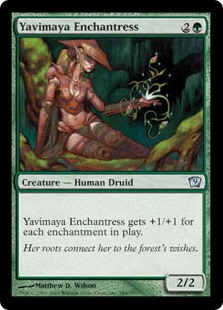
Don't worry, Yavimaya Enchantress, a little plastic surgery and we'll have you looking completely human. It's better this way: most of your druid friends are already human. Yeah, there are elves that are becoming druids too, but you're one of those old-school druids. You probably wouldn't want to hang out with them anyway!
And of course, there were other casualties...
Don't worry, Yavimaya Enchantress, a little plastic surgery and we'll have you looking completely human. It's better this way: most of your druid friends are already human. Yeah, there are elves that are becoming druids too, but you're one of those old-school druids. You probably wouldn't want to hang out with them anyway!
Oversoul
The Tentacled One
Human druid makes sense, though. Human druids built Stonehenge.
Human druids with pointy ears?

turgy22
Nothing Special
Those ears are clearly prosthetic.
I think we're arguing two different things here. The Yavimaya Enchantress gripe is more about revisionist card-typing causing art mismatches. I think that's a legitimate complaint and there are tons of examples of where that got screwed up.
What I was getting at was about the revisionist card-typing not matching ANYTHING about the card. An allosaurus is not a lizard. Period. The name of the card is Pygmy Allosaurus. It's a dinosaur. It'd be more akin to a card like Llanowar Elves (or any of the thousands of cards with "elf" in the title) changing type from elf to human.
I also vaguely recall, right around when Onslaught came out, Mountain Goat's creature type was changed from goat to beast. Onslaught was released with a bunch of cards depicting goats, but each one was typed as a beast. Obviously, this was done to fit the creature type theme. They styled a bunch of goat creatures for that world, said "hey, we had a goat already, but now all our goats are beasts" and changed Mountain Goat to a beast. Then, years later, they changed their mind and moved the whole swath of Onslaught goat-beasts to Goat Beasts. Which, I suppose is some order of magnitude more ridiculous than when they started.
Did I get off on a tangent? I can't really tell. Anyway, I've spent too much time thinking about this. I should have just written a new article.
Oversoul
The Tentacled One
I agree that botching the "human" part of Yavimaya Enchantress isn't comparable to the revision of Pygmy Allosaurus into a lizard. I brought it up because they're both cases where a creature type on a card was blatantly incorrect. They're the same in that respect, but that's where the similarity ends. And yeah, with Yavimaya Enchantress it was just the art, whereas with Pygmy Allosaurus it's right there in the name.
turgy22
Nothing Special
Good policy. When in doubt, rely on the ignorance of our ancestors.
I just thought they should have kept the "dinosaur" creature type. Or, if that made them too uncomfortable, they could have created a new type (like, Saurus) that is used to categorize beasts with leathery skin.
I just thought they should have kept the "dinosaur" creature type. Or, if that made them too uncomfortable, they could have created a new type (like, Saurus) that is used to categorize beasts with leathery skin.
Oversoul
The Tentacled One
Well, dinosaur does mean "thunder lizard".
Kind of. Without nerding this thread up with too much biology, I'll just put it like this...
People have been able to find dinosaur fossils throughout human history, but they used to come to unscientific conclusions like that they were the ancient bones of giants, dragons, or other mythical beings. In the 19th century, they did a bit better, attempting to reconstruct skeletons, but they got a lot wrong. Early attempts at reconstructions did (incorrectly) interpret dinosaurs as having been gigantic lizards. One of the first even got the name Iguanodon because the guy thought it was just a really big iguana. Richard Owen came up with "dinosaur" as group term for the three species that had been described by that point, but "dinosaur" doesn't mean "thunder lizard." The "dino-" morpheme doesn't mean "thunder." You're thinking of the "bronto-" in "brontosaurus." The "dino-" morpheme from Greek is usually taken to mean fearful or terrible. And the "saur" part usually interpreted as "lizard." But that's not quite right, because it predates the modern understanding of lizards as a taxonomic group. The "saur" included crocodilians too, and those aren't considered lizards nowadays from what I've seen, not even by uneducated people. Since "crocodile" is a creature type in Magic, one could just as easily say that "saur" means "terrible crocodile" and errata Pygmy Allosaurus to be a crocodile. Cladistically, that might actually be a more accurate revision than "lizard." Although if we went that route, "bird" would probably be even better. I said I wasn't nerding this thread up, so I'll stop.
But first, I'll leave you with another taxonomic atrocity.
Oversoul said:Without nerding this thread up...
Too late!
I'm going to rebut and say you're half-right: "dino" does mean "terrible" but "saur" still means "lizard" (or "reptile"). So I guess I was half-right too.
Dinosaur wiki
Although the word dinosaur means "terrible lizard"...
(and gives a couple footnote references)
Oversoul said:I'll leave you with another taxonomic atrocity.
You're saying it should be a Spider?
Oversoul
The Tentacled One
Too late!
I'm going to rebut and say you're half-right: "dino" does mean "terrible" but "saur" still means "lizard" (or "reptile"). So I guess I was half-right too.
Dinosaur wiki
(and gives a couple footnote references)
To be clear, I am not saying that "terrible lizard" is an inaccurate translation for the term. I'm saying that it was a label devised by men who incorrectly thought of dinosaurs as lizards. For example, lizards walk with their four limbs spread out horizontally, whereas dinosaurs don't. But back in the first half of the 19th century, no one knew that.
Again, as far as I know (I might be mistaken), calling crocodiles lizards has fallen out of favor now, so much that no one seems to do it. But back then, they were thought of as the same. Biologists now know a lot more than was understood in the past. Tuataras were thought of as lizards too, and they're not (although I'd expect most people on seeing one would call it a lizard). Going even further back in history, it gets more messed up. Ancient people thought of whales as being fish (they swim in the water) and thought of bats as being birds (they fly through the air).
The etymology of "dinosaur" does contain a morpheme that ancient people would have used as a label for lizards (and other animals that people don't call lizards anymore). Going by etymology, if dinosaurs are lizards, whales are fish (go ahead and wiki it
 ). But I don't see any indication that Magic has ever been using etymology to decide its creature type system. What's frustrating about the Pygmy Allosaurus case is that they'd already gotten it right: dinosaurs aren't lizards, but they didn't make it a lizard. They made it a dinosaur. It had a completely sensible creature type.
You're saying it should be a Spider?

I agree that it's an inaccurate label, the wiki entry says that Owen meant for the term to mean "majestic" or whatever (I'm not clicking the link again to find out specifically). But technically speaking, since you said
and it does, (or reptile), strictly translated.
And the "saur" part usually interpreted as "lizard." But that's not quite right
and it does, (or reptile), strictly translated.
Oversoul
The Tentacled One
I'm not sure what you mean by "it does" since you're quoting something that "it does" isn't a grammatically coherent response to. But if you mean that "saur" is correctly interpreted as "lizard" I think I've already addressed this twice. Yes, that's the usual translation and works well enough most of the time. I realize this. You don't need to cite a source for it. I'm already familiar with the term. But as I've said, there's more to it than that. Back when the word "dinosaur" was coined in the 1840's, there were living animals that were thought of as being lizards or in the same category as lizards and that no longer are. And back when the Greeks used the word that "saur" came from, the category would have been even fuzzier. Classification of living things has changed a lot over the course of history.
How do you define "lizard"? Well, you could look it up pretty easily in an encyclopedia and determine exactly what morphological characteristics unite lizards and distinguish them from other animals. In the past, people didn't have that luxury. It's easy now to say why a tuatara isn't a lizard, but I can see how, before it was studied scientifically, a scaly animal that crawls around on four legs, has a tail, and has a general frame the same as animals labeled lizards, would be thought of as just another lizard.
I don't consider etymology to be a very good method of decision-making for these matters anyway. Language changes. The word "dinosaur" is just a label. It's applied to a group of animals, but the origin isn't really informative by itself. We don't handle other things this way. At least I don't. If you think that I'm a wreath or that you and Turgy are eternal kings, you might disagree on that point! Anyway, what I'm getting at is that the word "dinosaur" was born out of a misunderstanding in the very early attempts at scientifically documenting fossil animals, and that the origin of the word shouldn't have any bearing on how we understand those animals 170 years later, but also that even if we did things that way, the concept behind the way "lizard" is now used isn't really the same as the concept behind the Greek term from which "saur" was derived (animals that would have been considered saurian in the past are not thought of as being lizards today).
Oh, and for even more of a mess, "saur" has since been used elsewhere. One important group of dinosaurs are named "sauropod." That's roughly "lizard-foot." Their feet are not even remotely lizardlike. I have no idea why that term was coined, but it's the name that was used first, so it has stuck.
How do you define "lizard"? Well, you could look it up pretty easily in an encyclopedia and determine exactly what morphological characteristics unite lizards and distinguish them from other animals. In the past, people didn't have that luxury. It's easy now to say why a tuatara isn't a lizard, but I can see how, before it was studied scientifically, a scaly animal that crawls around on four legs, has a tail, and has a general frame the same as animals labeled lizards, would be thought of as just another lizard.
I don't consider etymology to be a very good method of decision-making for these matters anyway. Language changes. The word "dinosaur" is just a label. It's applied to a group of animals, but the origin isn't really informative by itself. We don't handle other things this way. At least I don't. If you think that I'm a wreath or that you and Turgy are eternal kings, you might disagree on that point!
Anyway, what I'm getting at is that the word "dinosaur" was born out of a misunderstanding in the very early attempts at scientifically documenting fossil animals, and that the origin of the word shouldn't have any bearing on how we understand those animals 170 years later, but also that even if we did things that way, the concept behind the way "lizard" is now used isn't really the same as the concept behind the Greek term from which "saur" was derived (animals that would have been considered saurian in the past are not thought of as being lizards today).Oh, and for even more of a mess, "saur" has since been used elsewhere. One important group of dinosaurs are named "sauropod." That's roughly "lizard-foot." Their feet are not even remotely lizardlike. I have no idea why that term was coined, but it's the name that was used first, so it has stuck.
Oversoul
The Tentacled One
Giant Solifuge looks like a scorpion to me, on account of what appears to be a ginormous stinger coming from his behind.
Solifugae don't have stingers, but they also don't grow to be 20 feet wide or whatever...
Also, Pikachu is a rodent.
Confirmed. I fired up my Pokemon Blue and checked my Pokedex. Pikachu is a "mouse" pokemon. Mice are rodents, ergo Pikachu is a rodent.
Oversoul: Dude, I'm not arguing over what people thought things meant way back when or what they mean now. All I said was that "dinosaur" means "thunder lizard" and I was half right - it means "terrible lizard/reptile". "-saur" means "lizard" back then and today. Period.
And Pikachu is awesome...
And Pikachu is awesome...
Oversoul
The Tentacled One
I'd say, "there's more to it" but I've already done that a couple of times. I realize I'm touching on several different points here, but I'm trying to clarify what I believe to be the issue with Pygmy Allosaurus, and your comment about the etymology of "dinosaur" is only one part of that. You're reading everything I'm saying and interpreting the parts that aren't direct responses to your own words as irrelevant. I am not saying that you are wrong that the "saur" morpheme is derived from a label for lizards. You're right about that. But there are other details (such as the fact that it also referred to other, non-lizard, animals and the fact that the use of the morpheme in "dinosaur" originally came about due to a misconception anyway). It's quite a logical leap from "the word has a term for lizards in it" to "calling dinosaurs lizards is basically correct."
Also, etymology isn't meaning. Even simplifying the etymology of "dinosaur" to "terrible lizard" doesn't mean that dinosaurs are actually terrible lizards. That's just where the word came from. Similarly, "whale" comes from "sheath fish." But you agree that whales are not fish, right?
It's not just biology that gets names that only make sense in light of what some long-dead guy thought when he labeled things. Chemistry has some pretty bizarre nomenclature too. You know what formaldehyde is, right? But do you know why it's called that? Well, aldehydes were named based on the number of carbon atoms chained together, and formaldehyde is the smallest, with one. Traditionally, that meant the one-carbon adehyde was formaldehyde. Add another carbon atom to the chain and you get acetaldehyde. A third atom in the chain means it's propionaldehyde, and on it goes. Many of those prefixes were taken from carboxylic acids, and simply applied to other organic molecules. In the case of formaldehyde, the "form-" prefix refers to ants, and there's a genus of ants called Formica. The one-carbon carboxylic acid was discovered as a vapor coming from ant hills. So when the substance was isolated, it was named formic acid, and subsequently other organic molecules with the same carbon chain lengths inherited the name, which mean the one-carbon aldehyde became formaldehyde. There aren't any ants in it. It doesn't even have anything to do with ants. Another substance that's probably familiar, butane, got its name in a similar fashion: the carboxylic acid with a chain of four carbon atoms was named butyric acid because it was discovered in rancid butter (the Latin word for butter is "butyrum"), and "but-" became the default "4" prefix in organic chemistry, so four-carbon alkanes are butanes, even though butane actually has nothing to do with butter. These are just accidents of history, but the terminology can last for a long, long time.